
BMI Formula: How to Calculate Your Body Mass Index:
Medically reviewed by [Dr. Muhammad Sharif, FCPS, MCPS]. Last updated: October 3, 2026.
Body Mass Index comes from a simple math formula that compares your weight to your height. Doctors, researchers, and health agencies around the world use this same formula. Below, you’ll find the exact calculation, a worked example, and answers to common questions about how it works.
The BMI Formula:
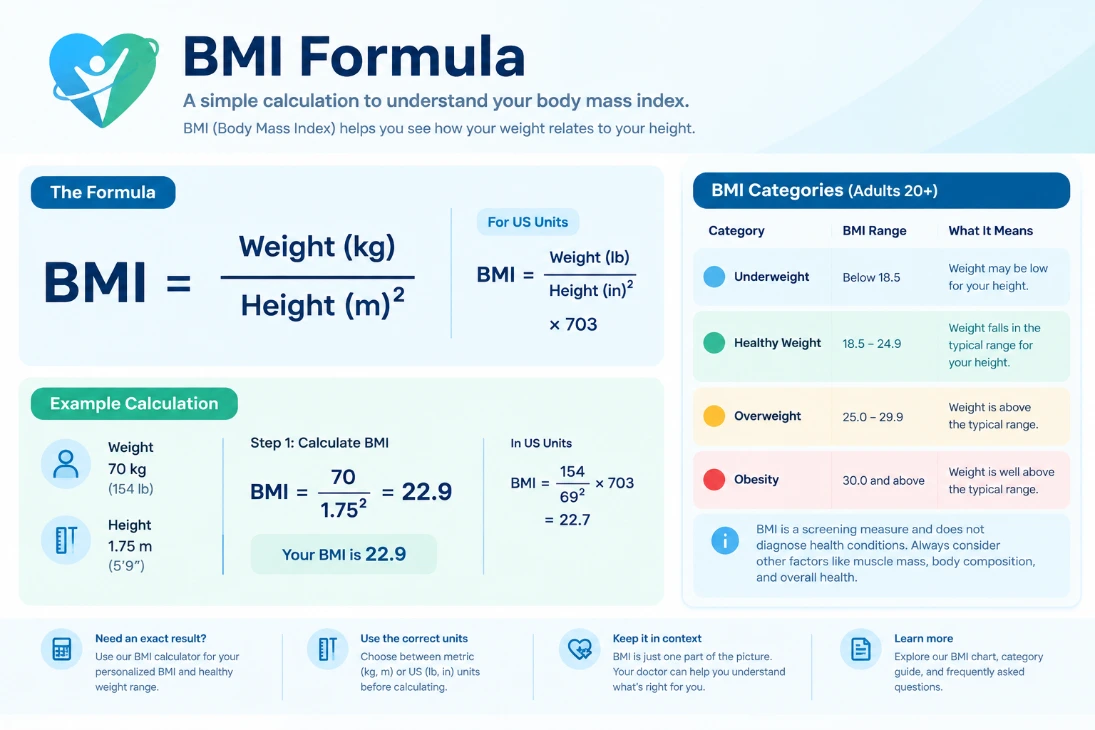
The standard formula, set by the World Health Organization, is:
BMI = weight in kilograms divided by height in meters squared
Written as an equation: BMI = kg / m²
This formula gives you a single number. That number is then matched against a set of standard ranges to show whether your weight falls in the underweight, healthy weight, overweight, or obesity category for your height.
BMI Formula for Pounds and Inches:
Most people in the United States measure weight in pounds and height in inches, not kilograms and meters. For these units, the formula changes slightly:
BMI = (weight in pounds divided by height in inches squared) multiplied by 703
Written as an equation:
BMI = (lbs / in²) × 703
The number 703 is a conversion factor. It adjusts the result so you get the same BMI value whether you use metric or US units.
Step by Step Example:
Here is how the formula works using real numbers. This example uses a person who is 5 feet 6 inches tall and weighs 150 pounds.
- Convert height to inches. 5 feet 6 inches equals 66 inches.
- Square the height. 66 multiplied by 66 equals 4,356.
- Divide weight by that number. 150 divided by 4,356 equals 0.0344.
- Multiply by 703. 0.0344 multiplied by 703 equals 24.2.
This person’s BMI is 24.2, which falls in the healthy weight range.
Metric Example:
For a person who is 168 centimeters tall and weighs 68 kilograms:
- Convert height to meters. 168 centimeters equals 1.68 meters.
- Square the height. 1.68 multiplied by 1.68 equals 2.82.
- Divide weight by that number. 68 divided by 2.82 equals 24.1.
This person’s BMI is also 24.1, close to the US unit example above, since both describe a similar body size.
BMI Formula Summary Table
| Unit System | Formula | Example Result |
|---|---|---|
| Metric (kg, m) | weight ÷ height² | 68 ÷ (1.68)² = 24.1 |
| US (lbs, in) | (weight ÷ height²) × 703 | (150 ÷ 66²) × 703 = 24.2 |
Why the Formula Uses Height Squared:
Weight does not increase at the same rate as height. A person who is twice as tall as another person is not simply twice as heavy if both have a typical build. Squaring the height in the formula helps account for this, so the resulting number works reasonably well across a wide range of heights. This method was first developed in the 1830s by a Belgian mathematician named Adolphe Quetelet, which is why BMI was originally called the Quetelet Index.
Do You Need to Calculate It by Hand:
No. The formula is useful to understand, but you do not need to do the math yourself. Our BMI calculator applies this exact formula and gives you your result in seconds, in either US or metric units. Calculating by hand is more useful for understanding how the number works than for everyday use.
Common Mistakes When Calculating BMI:
- Forgetting to square the height, which gives an incorrect, much lower result.
- Mixing units, such as using pounds with meters instead of pounds with inches.
- Rounding height or weight too early in the calculation, which can shift the final number slightly.
- Using the adult formula for a child or teenager, who needs an age and sex specific percentile instead.
BMI Formula for Children and Teens:
The formula itself is the same for children and teens, but the result is read differently. Instead of comparing the number to fixed categories, it’s compared to other children of the same age and sex using a percentile chart. A formula result that looks healthy for an adult could mean something different for a 12 year old. Use our Child and Teen BMI Calculator for anyone under 20 rather than the adult categories.
Limitations of the Formula:
The BMI formula is simple by design, which is both its strength and its weakness. It does not separate muscle from fat, so a muscular person can get a high result without carrying excess body fat. It also does not show where fat sits on the body, which matters for health risk. The formula gives a useful starting estimate, not a full picture of health.
Where to Check Your BMI Category:
Once you’ve calculated your BMI using the formula above, you can compare your result to our BMI chart to see which category it falls into, or review the full category table on that page for ranges by height.
Get Your BMI Without the Math:
While the formula is straightforward, using a calculator removes any chance of a calculation error and gives an instant result. Try our free BMI calculator for a fast, accurate number based on the same formula explained on this page.