
Ideal Body Weight Calculator
Find your estimated ideal body weight by height.
Choose your units and gender, enter your height, and get an ideal weight range based on four trusted medical formulas.
Your Ideal Body Weight
—
Your ideal weight estimate will appear here once calculated.
Medically reviewed by Dr. Muhammad Sharif (FCPS, MCPS), Last reviewed: October 5, 2026
Wondering how much you should weight for your height? Our ideal body weight calculator estimates body weight using four established formulas: Devine, Robinson, Miller and Hamwi. It also helps you compare those estimates with the broader healthy weight range based on BMI.
There is no single perfect weight for everyone. Height-based formulas are useful reference points, but they do not account for factors such as muscle mass, body composition or individual health.
What Is an Ideal Body Weight?
Ideal body weight is an estimated body weight based mainly on height and, depending on the formula, sex. It is a reference number rather than a medically required target.
Several formulas have been developed to estimate ideal body weight (IBW). They can produce different results for the same person because they were developed using different methods and for different purposes. Research comparing these formulas shows that they do not produce identical estimates.
For everyday health planning, it is often more useful to think about a healthy weight range rather than one exact number.
How Does the Ideal Body Weight Calculator Work?
Our calculator uses four commonly cited ideal body weight calculator formulas:
- Devine Formula
- Robinson Formula
- Miller Formula
- Hamwi Formula
Enter your:
- Sex
- Height
- Choose your preferred unit system: US customary or metric
The calculator then shows the estimated result from each formula.
Because the formulas can give different answers, comparing them gives you a better understanding of the range rather than treating one number as your exact target.
Ideal Weight Formulas Explained
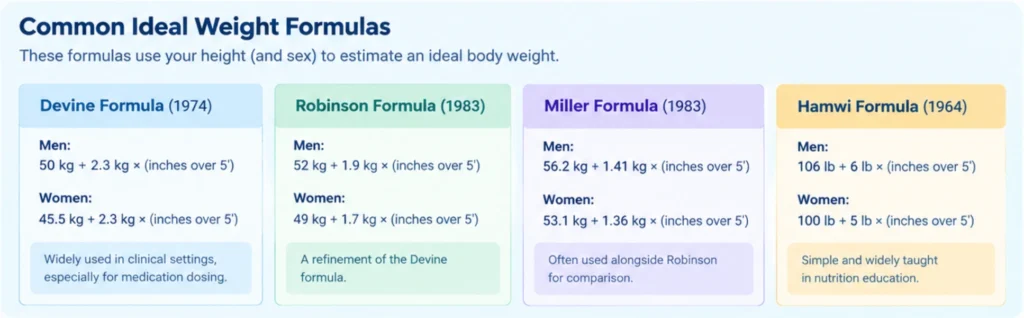
1. Devine Formula
The Devine formula was published in 1974 and became widely used in clinical settings, particularly for medication-dosing calculations. (Source-Devine BJ. Gentamicin therapy. Drug Intelligence and Clinical Pharmacy. 1974;8:650 to 655.)
Men:
Ideal body weight = 50 kg + 2.3 kg × each inch over 5 feet
Women:
Ideal body weight = 45.5 kg + 2.3 kg × each inch over 5 feet
Example:
For a man who is 5 feet 10 inches tall:
- 10 inches over 5 feet
- 50 + (2.3 × 10)
- = 73 kg
- ≈ 161 lb
The Devine formula is widely cited, but it should not be interpreted as the one universally correct weight for an individual.
2. Robinson Formula
The Robinson formula was published in 1983 using height-and-weight data derived from Metropolitan Life Insurance tables. (Source-Robinson JD, Lupkiewicz SM, Palenik L, Lopez LM, Ariet M. Determination of ideal body weight for drug dosage calculations. American Journal of Hospital Pharmacy. 1983;40(6):1016 to 1019.)
Men:
52 kg + 1.9 kg × each inch over 5 feet
Women:
49 kg + 1.7 kg × each inch over 5 feet
3. Miller Formula
The Miller formula is another 1983 ideal body weight equation. (Source -Miller DR, Carlson JD, Lloyd BJ, Day BJ. Determining ideal body weight (and mass). American Journal of Hospital Pharmacy. 1983;40:1622 to 1625.)
Men:
56.2 kg + 1.41 kg × each inch over 5 feet
Women:
53.1 kg + 1.36 kg × each inch over 5 feet
These formulas produce different estimates because they use different coefficients and underlying data.
4. Hamwi Formula
The Hamwi formula was published in 1964 and is another commonly referenced height-based method. (Source -Hamwi GJ. Therapy: changing dietary concepts. In: Danowski TS, ed. Diabetes Mellitus: Diagnosis and Treatment. Vol 1. New York: American Diabetes Association; 1964:73 to 78.)
Men:
106 lb + 6 lb × each inch over 5 feet
Women:
100 lb + 5 lb × each inch over 5 feet
Which Ideal Weight Formula Is Most Accurate?
There is no single ideal weight formula that is perfectly accurate for every person.
Devine is particularly well known in clinical and medication-dosing contexts, while Robinson, Miller and Hamwi provide alternative estimates.
The formulas use limited information ,primarily height and sex ,therefor they cannot fully account for:
- Muscle mass
- Body composition
- Bone structure
- Fat distribution
- Individual medical conditions
- Fitness level
A 2016 paper in the American Journal of Clinical Nutrition found that the classic equations do not line up with BMI ranges and can overestimate or underestimate weight at the shortest and tallest heights, so it is better to treat their results as estimates rather than exact targets.
How Much Should I Weigh for My Height?
There is no single weight that everyone of the same height should weigh.
For adults, one useful reference is the BMI healthy-weight range of 18.5 to less than 25. CDC and NHLBI use this range for adult healthy weight.
For example, CDC’s BMI categories show that a 5’9″ adult has a healthy-weight range of approximately 125–168 pounds.
This is broader than the results produced by the classic ideal-body-weight formulas.
The important distinction:
Ideal body weight calculator formulas:
Give an estimated point value.
BMI healthy-weight range:
Gives a broader range for a given height.
That’s why two calculators may give different answers without either one necessarily being mathematically wrong.
Ideal Weight by Height
The table below shows the adult healthy-weight range corresponding to BMI 18.5–24.9, rather than calling a single formula result an exact “ideal weight.”
| Height | Approx. healthy weight range |
|---|---|
| 5′-0″ | 95–128 lb |
| 5′-2″ | 101–136 lb |
| 5′-4″ | 108–145 lb |
| 5′-6″ | 115–154 lb |
| 5′-8″ | 122–164 lb |
| 5′-10″ | 129–174 lb |
| 6′-0″ | 136–184 lb |
| 6′-2″ | 144–194 lb |
These figures are based on the adult BMI range of 18.5–24.9 and are intended as a general reference, not a personalized medical target.
For your exact result, use the ideal weight calculator above.
Ideal Weight for Men vs. Women
Yes, classic ideal body weight calculator formulas generally give different results for men and women of the same height.
For example, the Devine formula uses:
- Men: 50 kg at 5 feet + 2.3 kg per additional inch
- Women: 45.5 kg at 5 feet + 2.3 kg per additional inch
However, the standard adult BMI categories themselves are not different for men and women. CDC’s adult BMI categories apply to adults 20 and older regardless of sex.
This is an important reason not to confuse an ideal-body-weight formula with the BMI classification system.
Does Age Affect Ideal Weight?
Age is not included in the classic Devine, Robinson, Miller or Hamwi formulas.
However, age can affect body composition, muscle mass and other health factors. Therefore, an ideal-weight formula should not be treated as a complete assessment of whether your weight is appropriate.
For adults, CDC’s standard BMI categories are applied regardless of age, sex or race, but BMI should be considered alongside other health information.
Is Ideal Weight the Same as Healthy Weight?
No. The terms are often used interchangeably online, but they are not exactly the same.
Ideal body weight (IBW) usually refers to an estimate generated by a specific formula such as Devine, Robinson, Miller or Hamwi.
Healthy weight is broader. For adults, BMI is one commonly used screening measure, with 18.5–24.9 generally classified as the healthy-weight range.
Your formula result can therefore be different from the upper or lower end of your BMI healthy-weight range.
Can You Be Healthy Above Your Ideal Weight?
Yes. A height-based formula cannot determine your complete body composition or overall health.
For example, someone with substantial muscle mass may weigh more than a formula predicts while having relatively low body fat.
BMI has similar limitations because it does not distinguish between muscle, fat and bone mass. CDC recommends considering BMI together with other health information rather than using it alone.
This is one reason your ideal weight should be viewed as a reference point, not a number you must reach.
Does Ideal Weight Account for Muscle Mass?
No. Classic ideal body weight calculator formulas do not directly account for muscle mass.
They primarily use height and sex.
This matters for athletes, bodybuilders and other people with unusually high muscle mass. A person can weigh more than a height-based estimate without having the same health profile as someone whose additional weight comes primarily from body fat.
Ideal Weight vs. BMI: What’s the Difference?
The easiest way to understand the difference is:
BMI asks:
“How does my current weight compare with my height?”
Ideal weight formulas ask:
“What weight does a particular formula estimate for my height?”
BMI is calculated from weight and height, while ideal body weight calculator formulas work backward from height to estimate a weight.
For a fuller picture, you can use both tools:
BMI Calculator → evaluate your current weight relative to height.
BMI Chart → understand BMI categories.
BMI Formula → learn how BMI is calculated.
Can I Use an Ideal Weight Calculator for Children?
Classic adult ideal-weight formulas should not be used as a substitute for pediatric growth assessment.
Children and teenagers are still growing, so their weight status is interpreted differently. CDC recommends BMI-for-age percentiles for children and teens rather than applying adult BMI categories directly.
If you’re evaluating a child’s weight, use an appropriate Child & Teen BMI Calculator and discuss the result with a pediatric healthcare professional.
Can I Use an Ideal Weight Calculator During Pregnancy?
An ordinary ideal-weight calculator is not an appropriate way to determine a healthy pregnancy weight target.
Pregnancy changes body weight for normal physiological reasons, so pregnancy-specific guidance should be used instead.
If you are pregnant and concerned about your weight or weight gain, discuss your individual target with your healthcare provider.
How to Use Your Ideal Weight Result
Use your result as a starting point, not a strict goal.
Step 1: Enter your height:
Choose either:
- Feet and inches
- Centimeters
Step 2: Select your sex:
The classic formulas use different constants for men and women.
Step 3: Compare the formulas:
Look at the Devine, Robinson, Miller and Hamwi estimates.
Step 4: Check your BMI:
Use your current weight with our BMI Calculator to see where you fall within the adult BMI categories.
Step 5: Consider the bigger picture:
Your weight is only one part of health. Other information—including medical history, physical activity, body composition and other health measurements—can provide additional context.
Why Do Different Ideal Weight Calculators Give Different Answers?
Because they may use different formulas.
For example, Devine, Robinson, Miller and Hamwi use different starting weights and different weight increments for height.
A 2000 review in the Annals of Pharmacotherapy found that the classic equations are similar because they came from the same height and weight tables, but they are not identical.
So if one calculator says your ideal weight is 160 lb and another says 165 lb, that doesn’t necessarily mean one calculator is broken.
Check which formula each calculator uses.
Is There Really One Ideal Weight?
No. There is not one universally correct ideal weight for every person.
A more realistic approach is to use:
- An ideal-weight formula as a reference
- The adult BMI healthy-weight range as a broader screening range
- Body composition and waist measurements where appropriate
- Your medical history and overall health
- Guidance from a qualified healthcare professional when needed
The goal should be healthy and sustainable, rather than reaching an arbitrary number on a calculator.
Frequently Asked Questions
What is the ideal weight for my height?
Your ideal weight depends mainly on your height and the formula used. Use the calculator above to compare several established formulas and then compare the result with the broader healthy BMI range.
How much should I weigh?
There is no single correct answer. For adults, a BMI of 18.5 to less than 25 is generally classified as the healthy-weight range, but BMI is a screening measure and should be considered with other health factors.
What is the ideal weight for a 5-foot person?
The answer depends on the formula. The adult BMI healthy-weight range for someone who is 5 feet tall is approximately 95–128 pounds. An ideal-body-weight formula will produce a different point estimate.
What is the ideal weight for a 5’6″ person?
The adult BMI healthy-weight range for someone 5’6″ tall is approximately 115–154 pounds. The classic ideal-weight formulas may produce a narrower estimate.
What is the ideal weight for a 5’10” person?
The adult BMI healthy-weight range for someone 5’10” tall is approximately 129–174 pounds. Your ideal-body-weight formula result may be narrower than this range.
Is the Devine formula accurate?
The Devine formula is a widely cited ideal body weight calculator equation, particularly in clinical drug-dosing contexts, but it is not a precise measure of an individual’s healthiest weight.
Which ideal weight formula should I use?
There is no universally best formula. Comparing Devine, Robinson, Miller and Hamwi gives more context than relying on one number.
Does ideal weight depend on gender?
Classic ideal body weight calculator formulas use different constants for men and women. Standard adult BMI categories, however, use the same BMI thresholds regardless of sex.
Does ideal weight depend on age?
The classic formulas do not use age. However, age-related changes in muscle mass and body composition can affect how an individual should interpret the result.
Can muscular people weigh more than their ideal weight?
Yes. Height-based formulas do not directly account for muscle mass or body composition. BMI also has limitations because it cannot distinguish muscle from fat.
Bottom Line
An ideal weight calculator gives you an estimate, not a perfect number.
The Devine, Robinson, Miller and Hamwi formulas can provide useful reference points, but they produce different results and do not capture every factor that influences healthy weight.
For adults, comparing the formula estimates with the BMI healthy-weight range of 18.5–24.9 gives a more useful picture than chasing one “perfect” number.
Use our Ideal Weight Calculator above to calculate your results, then check your current weight with our BMI Calculator.