
BMI for Women: Healthy Range, Chart and What Your Number Means
Medically reviewed by Dr. Muhammad Sharif (FCPS, MCPS). Last reviewed: 10-Oct-2026
Quick answer: A healthy BMI for an adult woman is 18.5 to 24.9. A BMI below 18.5 is underweight, 25.0 to 29.9 is overweight, and 30.0 or higher is obesity. These ranges are the same for women and men and do not change with adult age. BMI is a screening number, not a diagnosis, and it is read differently for girls, teens, and during pregnancy.
This guide explains BMI for women in plain language. You will find the healthy range, a height and weight chart, and how age, menopause, pregnancy, and body type can change what your number means. To get your own result, use our BMI calculator.
What Does BMI for Women Means?
BMI stands for Body Mass Index. It compares your weight with your height. The formula is weight in kilograms divided by height in meters squared. Our BMI formula guide shows worked examples in pounds and kilograms.
Doctors use BMI as a quick first check because it needs only two measurements. It does not measure body fat directly, and it cannot tell muscle from fat.
What Is a Healthy BMI for Women?
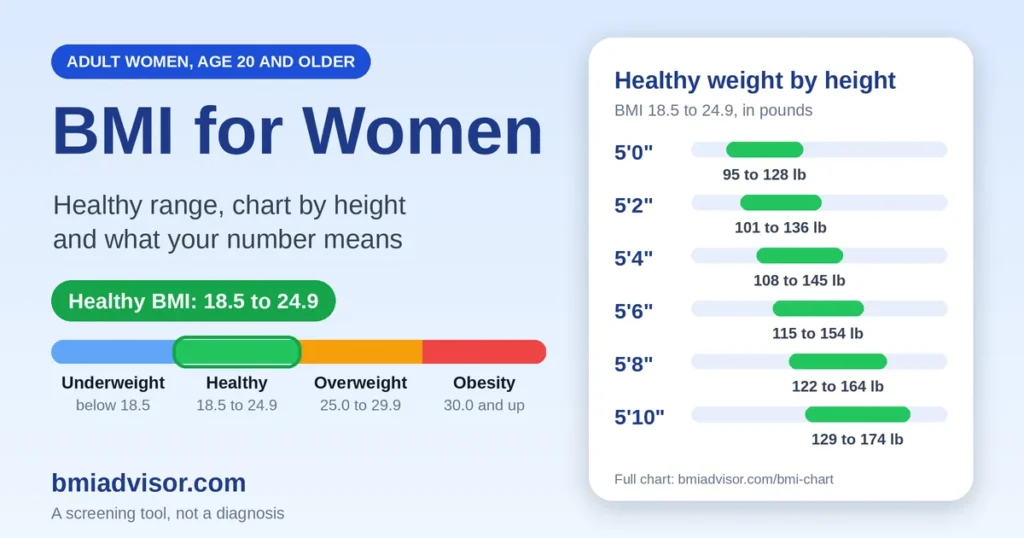
For adult women age 20 and older, the CDC defines a healthy weight as a BMI from 18.5 to less than 25.
| Category | BMI |
|---|---|
| Underweight | Below 18.5 |
| Healthy weight | 18.5 to 24.9 |
| Overweight | 25.0 to 29.9 |
| Obesity | 30.0 or higher |
The CDC uses these cutoffs regardless of age, sex, or race.
What BMI Is Considered Overweight for Women?
A BMI of 25.0 to 29.9 falls in the overweight category for adult women. Some UK guidance uses lower cutoffs for women from certain ethnic backgrounds, covered below.
BMI Chart for Women by Height
This table shows the weight range that gives a healthy BMI of 18.5 to 24.9 at common heights.
| Height | Healthy weight range |
|---|---|
| 5′-0″ | 95 to 128 lb |
| 5′-2″ | 101 to 136 lb |
| 5′-4″ | 108 to 145 lb |
| 5′-6″ | 115 to 154 lb |
| 5′-8″ | 122 to 164 lb |
| 5′-10″ | 129 to 174 lb |
Your height is not listed? Our BMI chart covers more details.
Is BMI Different for Women and Men?
The BMI categories are the same, but bodies are not. Studies that measure body fat directly find that at the same BMI, women carry more body fat than men throughout adult life. This is one reason BMI works as a rough screen and not as a body fat test.
BMI for Women by Age
For women age 20 and older, the healthy range stays 18.5 to 24.9 at every age. What changes is how well BMI reflects body fat.
A 1996 study found that older adults carry more body fat than younger adults at the same BMI. Muscle loss with age can hide fat gain.
Menopause adds another shift. During the menopause transition, many women see fat move toward the waist and muscle decline, even when the scale changes little. BMI for women can miss this, so waist size gives useful extra information.
BMI and Ethnic Background
UK guidance from NICE recommends lower BMI cutoffs for adults with a South Asian, Chinese, other Asian, Middle Eastern, Black African, or African Caribbean family background. NICE uses 23 to 27.4 for overweight and 27.5 or higher for obesity, because health risk can begin at a lower BMI in these groups.
The table above shows the standard CDC ranges used in the United States. If your background is on the NICE list, ask your doctor which cutoffs apply to you.
BMI During Pregnancy
Do not use a standard BMI chart to judge your weight during pregnancy. Weight rises for normal reasons, so adult categories do not apply.
Doctors use your BMI from before pregnancy to set a healthy weight gain range, based on 2009 Institute of Medicine guidelines. Ask your midwife or obstetrician for your own target.
BMI for Girls and Teens
Girls and teens ages 2 through 19 use BMI for age percentiles, not adult cutoffs. The CDC compares a girl’s BMI with other girls of the same age. Below the 5th percentile is underweight, the 5th to below the 85th is healthy weight, the 85th to below the 95th is overweight, and the 95th or higher is obesity.
What to Use Instead of BMI, or Alongside It
BMI alone does not show where your body stores fat or how healthy you are. Doctors often add:
- Waist to height ratio. Divide your waist by your height. NICE advises keeping it under 0.5. A ratio of 0.5 to 0.59 signals increased health risk, and 0.6 or more signals further increased risk.
- Blood pressure, blood sugar, and cholesterol.
- Body composition tests, such as a DEXA scan, if your doctor thinks one would help.
- Medical history and a physical exam.
What to Do With Your BMI Result
- Below 18.5: talk with a doctor about possible causes.
- 18.5 to 24.9: keep up your habits and check your waist to height ratio.
- 25 or higher: this is a prompt to look closer, not a diagnosis. Ask your doctor about waist size, blood pressure, and blood sugar.
Frequently Asked Questions
What is a normal BMI for a woman by age?
It is 18.5 to 24.9 for any adult woman age 20 or older. Under 20, results are read as percentiles.
How do you calculate BMI for a woman?
Divide weight in kilograms by height in meters squared. With pounds and inches, divide weight by height in inches squared and multiply by 703. Or enter your numbers in our calculator.
Is a BMI of 25 bad for a woman?
Not by itself. A BMI of 25.0 to 29.9 is classed as overweight, but BMI does not show body fat or health. Talk with your doctor about your waist size and other checks.
Can a muscular woman have a high BMI and still be healthy?
Yes. BMI counts muscle and fat the same, so a strong, active woman can land in the overweight range with a healthy amount of body fat. Waist size and a body composition test give a clearer picture.
Does BMI change after menopause?
The categories stay the same. Body fat tends to shift toward the waist, so waist measurements matter more.
What should women use instead of BMI?
Use BMI together with waist to height ratio, blood pressure, blood sugar, and cholesterol. A doctor can advise which tests suit you.
Can I use BMI during pregnancy?
No. Doctors use your BMI from before pregnancy to guide weight gain. Ask your care team for your target.
Final Thoughts
BMI for women is a quick, free first check, not a verdict on your health. Know your range, remember its limits, and look at waist size and other measures too. Ready to check your number? Use our BMI calculator.
This page is for information only and is not medical advice. Talk with a doctor about your results. Read our Medical Disclaimer and Medical Review Policy.
Sources
- Centers for Disease Control and Prevention. Adult BMI Categories.
- Centers for Disease Control and Prevention. Child and Teen BMI Categories.
- National Institute for Health and Care Excellence. Overweight and obesity management (NG246): identifying and assessing overweight, obesity and central adiposity.
- Gallagher D, et al. How useful is body mass index for comparison of body fatness across age, sex, and ethnic groups? American Journal of Epidemiology. 1996;143(3):228 to 239.
- Changes in body composition and weight during the menopause transition. JCI Insight. 2019;4(5):e124865.
- Centers for Disease Control and Prevention. Gestational Weight Gain, United States, 2012 and 2013. MMWR. 2015;64(43).