
Calorie Calculator
Estimate the calories you need to maintain, lose, or gain weight.
More options: pace, goal weight, formula
Need your body fat? Try our Body Fat Calculator. A goal date sets your pace, within safe limits.
More details and activity levels
| Activity level | Maintain | Your goal |
|---|
Estimates only, often off by 10% or more. Not for under 18, pregnancy, breastfeeding, or eating disorder recovery. Talk with a doctor or dietitian about your plan. Your numbers stay in your browser.
Medically reviewed by Dr. Muhammad Sharif (FCPS, MCPS). Last reviewed: 23-Oct-2026
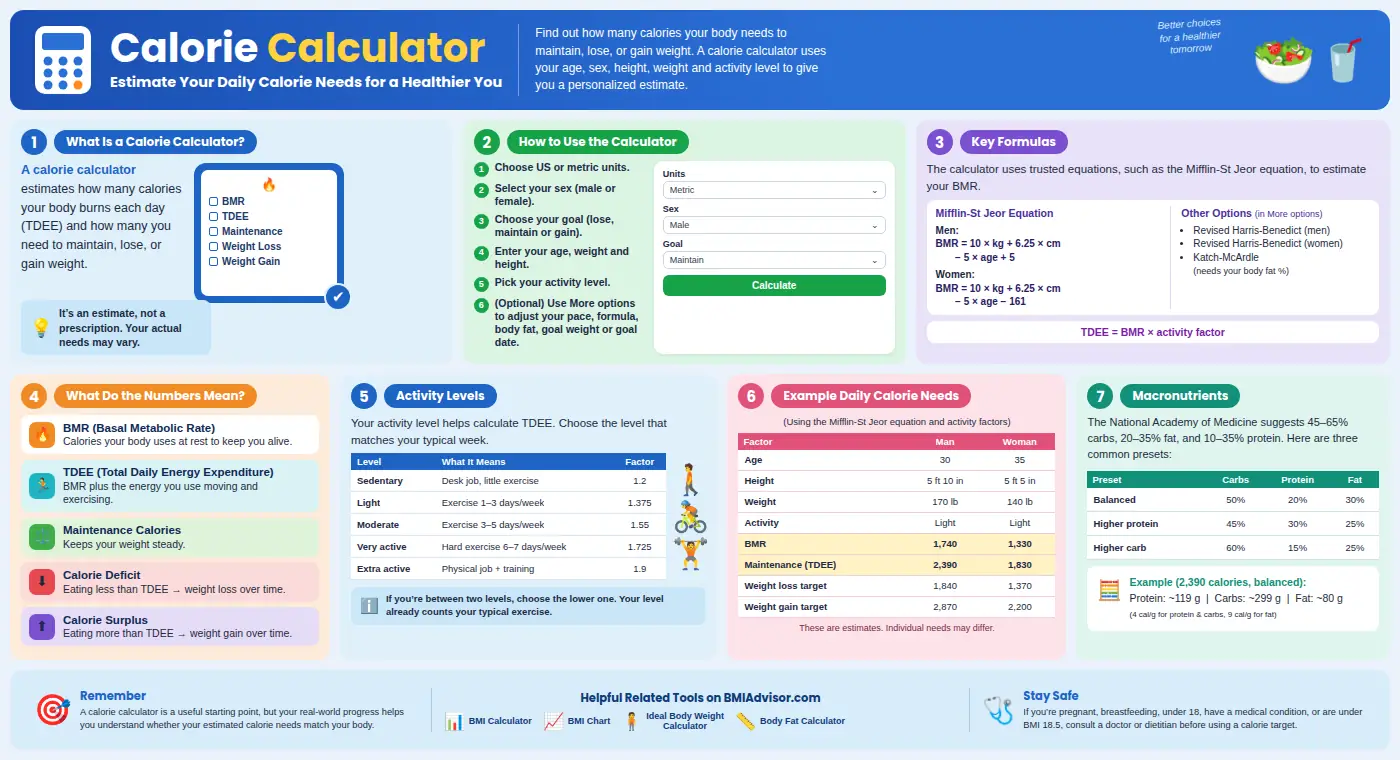
Quick answer: A calorie calculator estimates how many calories your body burns each day and how many you need to maintain, lose, or gain weight. It uses your age, sex, height, weight, and activity level. For example, a 30 year old man who is 5 ft 10 in, weighs 170 lb, and exercises lightly burns about 2,390 calories a day. Treat any result as an estimate, not a prescription.
How to Use This Calorie Calculator
- Choose US or metric units.
- Pick the sex used in the equation, male or female.
- Choose Lose weight, Maintain, or Gain weight.
- Enter your age, weight, and height.
- Pick the activity level that matches a typical week.
- Open More options to change your pace, formula, body fat, goal weight, or goal date.
You will see your daily calories, BMR, maintenance calories, macros, BMI, and a table of needs at each activity level. The tool is for adults aged 18 and older who are not pregnant or breastfeeding. Your numbers stay in your browser.
What Are BMR, TDEE, and Maintenance Calories?
| Term | Meaning |
|---|---|
| BMR (basal metabolic rate) | Calories your body uses at rest to keep you alive |
| TDEE (total daily energy expenditure) | BMR plus the energy you use moving and exercising |
| Maintenance calories | The same as TDEE. Eating this amount keeps your weight steady |
| Calorie deficit | Eating below TDEE, which leads to weight loss over time |
| Calorie surplus | Eating above TDEE, which leads to weight gain over time |
People often search for a TDEE calculator or a BMR calculator. This tool shows both numbers. The link is simple: BMR × activity factor = TDEE. Eat below it to lose weight, near it to maintain, and above it to gain.
Activity Levels Explained
| Level | What it means | Factor |
|---|---|---|
| Sedentary | Desk job, little exercise | 1.2 |
| Light | Exercise 1 to 3 days a week | 1.375 |
| Moderate | Exercise 3 to 5 days a week | 1.55 |
| Very active | Hard exercise 6 to 7 days a week | 1.725 |
| Extra active | Physical job plus training | 1.9 |
Many people choose a level that is too high. If you are between two levels, pick the lower one and adjust with real results. Your level already counts typical exercise, so do not add workout calories on top.
Calorie Calculator Formulas
The default is the Mifflin-St Jeor equation:
- Men: BMR = 10 × weight in kg plus 6.25 × height in cm minus 5 × age plus 5
- Women: BMR = 10 × weight in kg plus 6.25 × height in cm minus 5 × age minus 161
The 1990 study behind it measured 498 healthy adults aged 19 to 78. A later review found it more likely than other common equations to land within 10% of measured resting metabolic rate, though errors can be large for one person.
Under More options you can also choose:
- Revised Harris-Benedict (men): 88.362 plus 13.397 × kg plus 4.799 × cm minus 5.677 × age
- Revised Harris-Benedict (women): 447.593 plus 9.247 × kg plus 3.098 × cm minus 4.330 × age
- Katch-McArdle: 370 plus 21.6 × lean mass in kg. It needs your body fat, which you can estimate with our Body Fat Calculator.
TDEE is your BMR times the activity factor.
Example Results
| Man | Woman | |
|---|---|---|
| Age | 30 | 35 |
| Height | 5 ft 10 in | 5 ft 5 in |
| Weight | 170 lb | 140 lb |
| Activity | Light | Light |
| BMR | 1,740 | 1,330 |
| Maintenance (TDEE) | 2,390 | 1,830 |
| Weight loss target | 1,840 | 1,370 |
| Weight gain target | 2,870 | 2,200 |
For the man: 10 × 77.1 plus 6.25 × 177.8 minus 150 plus 5 is about 1,740, and 1,740 × 1.375 is about 2,390. The tool rounds to the nearest 10 and uses the standard pace. The woman’s loss and gain targets are limited to 25% below and 20% above her maintenance calories. These examples are estimates calculated using the Mifflin–St Jeor equation and the activity factors shown above. Individual energy needs may differ.
Calorie Calculator for Weight Loss: How Many Calories Should You Eat?
The CDC says people who lose about 1 to 2 pounds a week are more likely to keep the weight off. It also notes that even a 5% loss can improve blood pressure, cholesterol, and blood sugar for people not at a healthy weight.
A common rule says a 500 calorie daily deficit equals about 1 pound a week. That rule works for a few weeks, but it overestimates long term loss, because your body burns less as it gets smaller. The NIH Body Weight Planner uses a model that accounts for this slowdown.
The tool offers three paces: slow, standard, and faster. They match about 0.5, 1, and 1.5 pounds a week, or roughly 275, 550, and 825 calories a day below maintenance, before safety limits apply. Those limits are:
- No weight loss target if your BMI is under 18.5.
- No loss target below 1,200 calories for women or 1,500 for men. Harvard Health advises not going lower without medical supervision.
- A deficit capped at 25% of maintenance.
- A pace capped at 1% of body weight per week.
Add a goal weight and date, and the tool estimates when you could reach it. If the date needs an unsafe pace, it uses the fastest safe pace and shows a later date.
Calorie Calculator for Weight Gain: How Many Calories Should You Eat?
A calorie surplus means eating above maintenance. The tool caps the surplus at 20% above maintenance, so the gain stays gradual. Pair a surplus with strength training, and see a doctor if your BMI is under 18.5 or you are losing weight without trying.
Typical Daily Calories by Age and Sex
The Dietary Guidelines for Americans, 2025 to 2030, list these estimates for adults:
| Group | Sedentary | Active |
|---|---|---|
| Men 19 to 60 | 2,200 to 2,600 | 2,600 to 3,000 |
| Women 19 to 60 | 1,600 to 2,000 | 2,200 to 2,400 |
| Men 61 and older | 2,000 | 2,400 to 2,600 |
| Women 61 and older | 1,600 | 2,000 |
These are general ranges. Your own result depends on your size.
Macros: Protein, Carbs, and Fat
The National Academy of Medicine range for adults is 45 to 65% of calories from carbs, 20 to 35% from fat, and 10 to 35% from protein. The tool offers three presets inside that range:
| Preset | Carbs | Protein | Fat |
|---|---|---|---|
| Balanced | 50% | 20% | 30% |
| Higher protein | 45% | 30% | 25% |
| Higher carb | 60% | 15% | 25% |
Protein and carbs give 4 calories per gram, and fat gives 9. For 2,390 calories on the balanced preset, that is about 119 g protein, 299 g carbs, and 80 g fat.
Why Do Calorie Calculators Give Different Results?
Calculators differ for four reasons:
- They use different equations, such as Mifflin-St Jeor or Harris-Benedict.
- They define activity levels differently.
- They round differently.
- Your body is not an average body. Muscle, genes, and health all matter.
How accurate is a calorie calculator? It is a starting point. Eat at your target for 2 to 3 weeks, weigh yourself under the same conditions, and look at the weekly average. If nothing changes, adjust by a small amount, such as 100 to 200 calories, and check again.
Why Am I Not Losing Weight Even With a Calorie Deficit?
If you’re eating fewer calories but not losing weight, several factors may explain why:
- Hidden calories: Cooking oil, sauces, sugary drinks, and snacks can increase your daily calorie intake. Track everything you eat and drink.
- Overestimated activity: Choosing an activity level that’s too high can overestimate your maintenance calories. Select the level that best matches your typical routine.
- Water retention: Sodium, hormonal changes, and intense workouts can cause temporary weight fluctuations. Compare weekly average weights instead of daily readings.
- Inaccurate calorie estimates: A calorie calculator estimates your needs, but actual energy expenditure varies. As you lose weight, your calorie needs may also decrease.
What should you do? Track your food intake consistently, weigh yourself under similar conditions, and monitor your weight trend over 2–4 weeks. If your average weight remains unchanged, review your tracking and activity level before making a small adjustment to your calorie target.
Who Should Be Careful
Talk with a doctor or dietitian before using any calorie target if you:
- Are pregnant or breastfeeding, or are under 18.
- Have had an eating disorder.
- Have diabetes, thyroid disease, or another condition that affects weight or metabolism.
- Have a BMI under 18.5.
Frequently Asked Questions
How many calories should I eat a day?
It depends on your age, sex, size, and activity. Adults typically need between about 1,600 and 3,000 calories. Use the calculator above for your own estimate of maintenance calories.
What is the difference between BMR and TDEE?
BMR is what you burn at rest. TDEE is BMR plus the energy from daily movement and exercise. TDEE is your maintenance calories.
Should I eat back my exercise calories?
Not if your activity level already includes your workouts. Adding them on top can count the same exercise twice.
What is the minimum number of calories per day?
Harvard Health advises not going below 1,200 calories for women or 1,500 for men without medical supervision. This calculator will not set a weight loss target below those numbers.
How long will it take to reach my goal weight?
Enter a goal weight in More options. The tool gives an estimate, but real progress usually slows over time, so treat the date as a guide.
Is a lower calorie target always better?
No. Eating too little can slow progress and make it hard to get enough protein and nutrients. A gradual pace is easier to keep.
Final Thoughts
A calorie calculator turns your size and activity into a starting number. Use it to set a maintenance level, choose a gentle deficit or surplus, then adjust with real results. Check your BMI with our BMI calculator, see healthy weights in the BMI chart, and compare goals with the Ideal Body Weight Calculator.
This page is for information only and is not medical advice. Talk with a doctor or dietitian about your plan. Read our Medical Disclaimer.